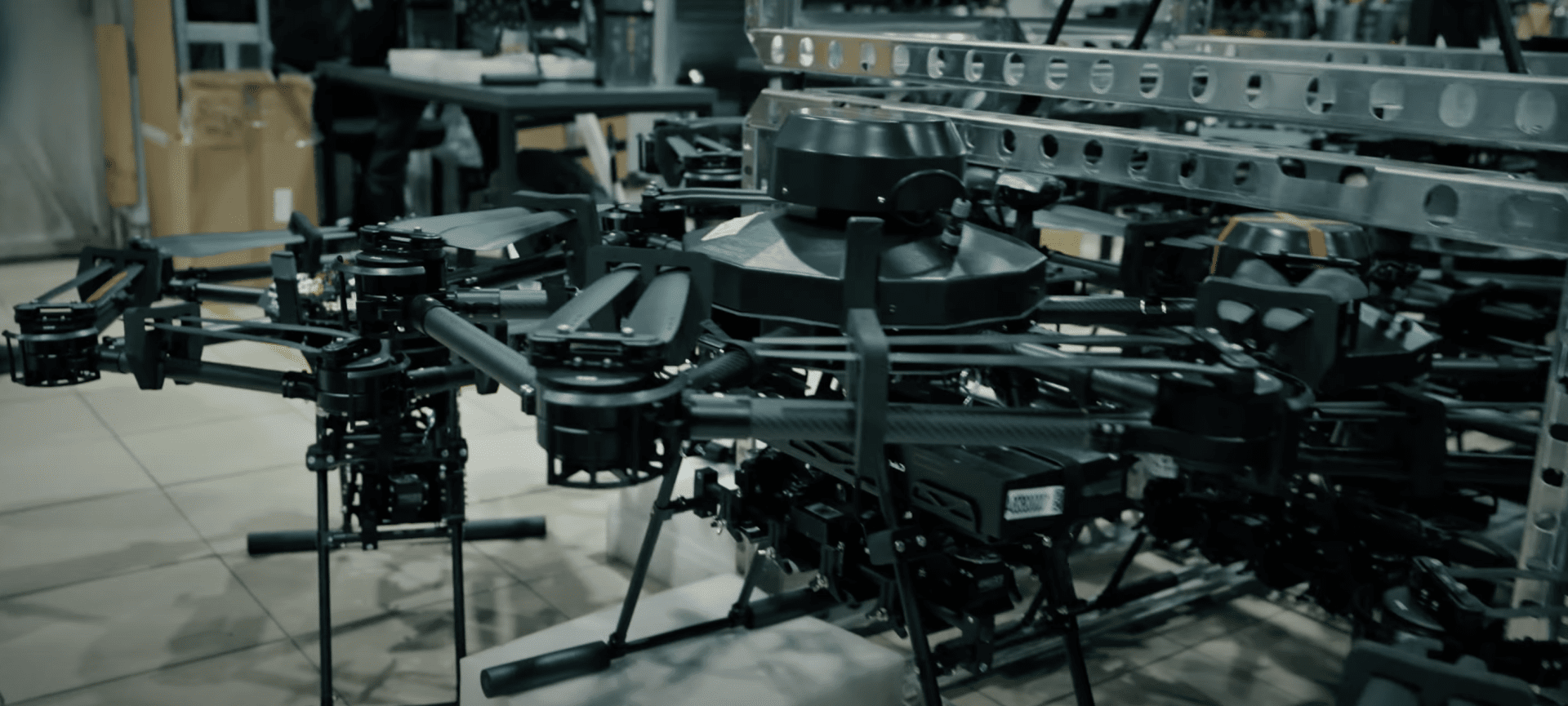

A high-security industrial site in Russia, previously kept under wraps, is now drawing international attention due to a significant and rapid transformation. Recent satellite imagery reveals major expansion efforts at a facility believed to be central to the country’s drone manufacturing program, while Russian officials have simultaneously allowed a rare look inside the plant—a move that has raised eyebrows among defense analysts and geopolitical observers.
The location, situated within the Alabuga Special Economic Zone in the Republic of Tatarstan, seems to be experiencing significant growth. Recent satellite images with high-resolution detail display increased construction efforts throughout the last year. New structures, improved infrastructure, and what seems to be improved logistical capabilities are now observable from an aerial perspective. These developments imply considerable financial investment aimed at increasing the production of unmanned aerial vehicles (UAVs), probably to meet the shifting requirements of Russia’s current military activities.
Although satellite monitoring has provided a perspective on the progress, Russia has done something uncommon by revealing aspects of its drone production process. State-run media channels have recently broadcasted scenes from within the factory, highlighting assembly lines, parts, and workers in action. Despite being carefully managed and likely designed to align with strategic communication objectives, the footage represented an unusual moment of openness for an industry typically enveloped in confidentiality.
This dual unveiling—both through independent observation and government-sanctioned media—highlights the increasing strategic value Moscow places on drone capabilities. Unmanned systems have become a key element in modern warfare, used for reconnaissance, targeting, and offensive strikes. Their utility in conflict zones, including Ukraine and beyond, has led to intensified focus on production and technological development within the defense sector.
Defense experts analyzing the satellite images point to several indicators of accelerated expansion. Among the most notable are the appearance of new structures consistent with production halls or warehouses, the extension of transport corridors, and the installation of support infrastructure, such as power and communications systems. These elements together indicate a move toward higher-volume output and greater operational autonomy.
The site’s placement inside a Special Economic Zone provides benefits like tax breaks, efficient logistics, and decreased regulation, all aiding in quicker development schedules. These zones aim to draw in investment and foster innovation, and here, they seem to be fulfilling a dual role by encouraging military-industrial expansion.
Russia’s decision to showcase the facility may be partly intended to send a message—both domestically and internationally. On one hand, it suggests confidence in the country’s manufacturing capabilities and a desire to project resilience despite sanctions and export controls. On the other, it may aim to influence perceptions of technological parity or superiority, especially in the context of ongoing geopolitical tensions and defense posturing.
Analysts point out that the facility seems to prioritize the construction of UAV systems that have been commonly used in recent conflicts. This encompasses loitering munitions—drones intended to remain over a target site prior to striking—and reconnaissance variants. Some sources indicate that manufacturing might entail authorized or reverse-engineered designs, possibly utilizing foreign technology or parts.
However, questions remain about the supply chains supporting this growth. Western sanctions and export restrictions have aimed to limit Russia’s access to advanced electronics, optics, and aerospace-grade materials. While some domestic workarounds and third-party channels may mitigate these constraints, the sustainability of large-scale drone manufacturing under such conditions is uncertain. Analysts continue to watch for signs of how Russia is sourcing critical parts and adapting designs to available materials.
The scale of the expansion also has broader implications for regional and global security. As UAVs become more central to military operations, the ability of one nation to rapidly boost its drone capabilities may prompt others to respond in kind, potentially leading to a wider arms race in unmanned systems. Moreover, the proliferation of drones raises concerns about asymmetric warfare, where even modest investments can yield significant tactical advantages.
From a technological standpoint, the footage and satellite data reveal a blend of manual and automated processes within the factory. Workers are seen assembling components by hand, but some areas feature conveyor lines and machine-assisted production tools. This hybrid approach suggests that while Russia is advancing its capabilities, it may still rely on labor-intensive methods in the absence of more sophisticated manufacturing infrastructure.
In addition to military considerations, the site’s development reflects a growing trend toward the integration of dual-use technologies—products and systems that serve both civilian and defense applications. Drones used in agricultural monitoring, infrastructure inspection, or emergency response can share core components with military variants. This overlap makes it harder to distinguish between purely commercial and explicitly military production, complicating efforts to regulate or restrict technology transfer.
The geopolitical context surrounding this expansion cannot be ignored. As global tensions rise and conflicts persist, the development and display of drone manufacturing facilities serve as both a functional necessity and a form of signaling. Russia’s willingness to lift the veil on such a facility—however partially—marks a shift in its public-facing defense posture. It suggests a narrative of self-reliance, industrial capability, and strategic adaptation in the face of international pressure.
International watchdogs, such as intelligence services and defense research organizations, are expected to keep an eye on the site’s progress. Routine satellite observations and public data evaluations have become essential in observing military-industrial activities, providing clarity in regions where official details are scarce or manipulated.
As the role of drones in global conflict continues to grow, so too will interest in the infrastructure behind them. The developments at Alabuga provide a snapshot of how one country is responding to that demand—through rapid construction, calculated transparency, and a complex web of logistics that supports its strategic goals. What remains to be seen is how this expansion will impact the broader balance of power in the unmanned systems domain, and whether other nations will escalate their own efforts in response.