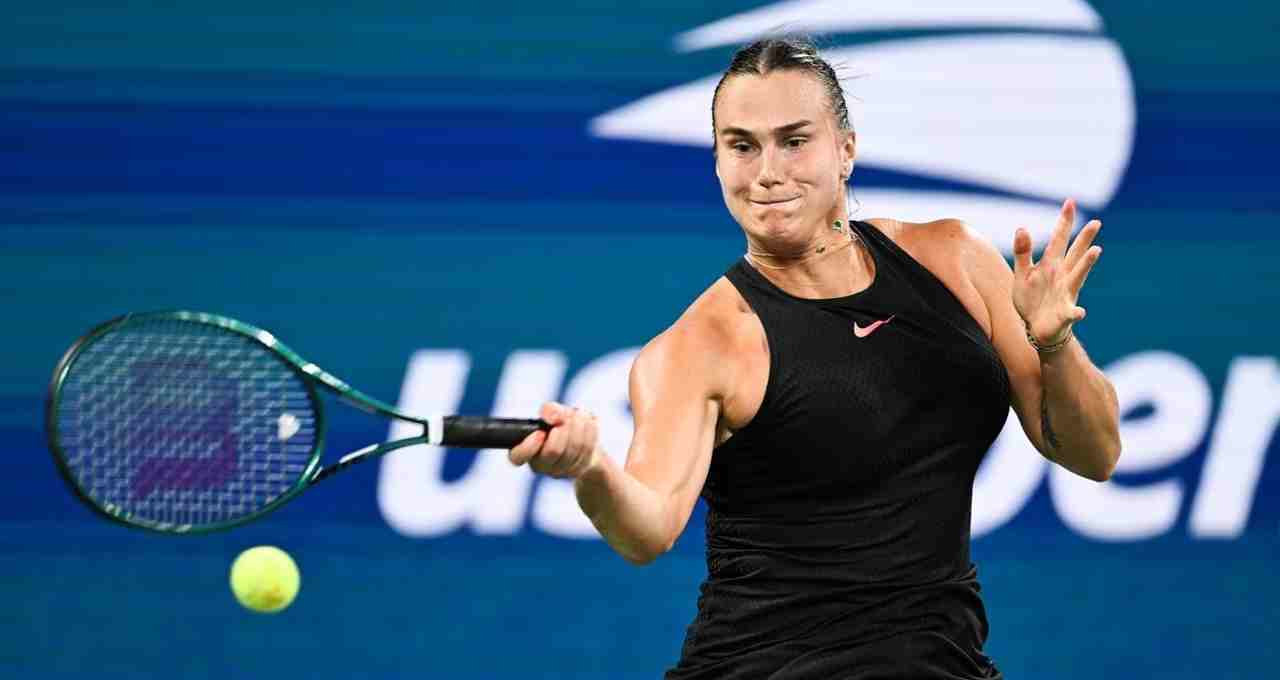

Aryna Sabalenka, the defending champion at the US Open, has advanced to the semifinals without having to play a full match after her scheduled opponent, Markéta Vondroušová, was forced to withdraw. This unexpected development marks a significant turning point in the tournament, as Sabalenka continues her quest to retain the title she won last year.
The automatic advancement marks another achievement in Sabalenka’s impressive series in New York, where she has consistently displayed strength, accuracy, and mental fortitude in all her games. Although many expected a fierce contest between the two athletes, Vondroušová’s inability to participate owing to injury signifies that the long-anticipated confrontation will not occur.
Sabalenka’s path through the competition has been marked by strong performances, and progressing in this manner provides her with extra opportunity to recuperate and get ready for the forthcoming stages. Managing physical recovery and conserving energy are frequently vital in Grand Slam tournaments, and at this point, a walkover may offer the Belarusian athlete a tactical edge against future rivals who have faced tough matches to reach this stage.
The US Open has always been a platform where resilience and adaptability determine success, and Sabalenka’s ability to remain focused despite sudden schedule changes reflects her maturity as a player. Grand Slam events often present unforeseen scenarios, and the capacity to handle them gracefully is what separates the top contenders from the rest. Sabalenka has shown repeatedly that she thrives under pressure and understands the dynamics of tournament play.
For Vondroušová, the withdrawal is undoubtedly disappointing. Injuries are part of the sport, yet they often disrupt the rhythm and momentum that players build over weeks of preparation. As the current Wimbledon champion, Vondroušová entered the US Open with high expectations, and fans were eager to witness how her tactical game would fare against Sabalenka’s powerful baseline approach. Unfortunately, the clash of styles will remain a hypothetical discussion this season.
The walkover also raises broader questions about the physical demands placed on professional tennis players during a packed season. With tournaments scheduled across continents and surfaces, managing injuries and recovery has become as strategic as match play itself. Sports science and player support teams are continuously working to reduce injury risks, but the nature of elite competition often pushes athletes to their limits.
Sabalenka’s progress to the semifinals keeps her on track to potentially achieve back-to-back titles at Flushing Meadows, a feat that would cement her status as one of the most dominant players on the current women’s tour. Winning consecutive US Opens is a rare accomplishment, reflecting consistency, mental toughness, and adaptability to changing conditions and opponents.
The upcoming stage is expected to be quite challenging, given that the competitors left in the competition are high-ranking and have shown excellent performances in the event. Sabalenka will need to focus on analyzing possible semifinal rivals, polishing her strategies, and keeping the self-assurance that has characterized her recent achievements on hard surfaces.
Beyond the rivals, Sabalenka’s progress narrative also underscores the unexpected nature of professional tennis. Both supporters and experts recognize that, while talent and tactics influence the results on the court, external factors can significantly impact the direction of a tournament. For the audience, missing a high-profile quarterfinal is disappointing, but excitement for the semifinals is still strong, particularly with Sabalenka still competing.
As the competition nears its peak, everyone will be watching Sabalenka to determine if she can persist in her advance towards another title. Her combination of striking strength and evolving strategic adaptability makes her a tough competitor for any rival. With extra rest and preparation, she arrives at the semifinals not only as the reigning champion but also as an athlete invigorated to tackle the concluding phases of one of tennis’s most esteemed tournaments.
The US Open remains a display of remarkable athletic performance, surprising turns, and emotional peaks and valleys that captivate spectators from the initial round to the finals. Sabalenka’s recent progress serves as a reminder that in tennis, determination, meticulous planning, and the ability to adapt frequently shape champions just as much as innate skill. Whether this unforeseen edge will lead her to another victory is yet to be determined, but one thing is certain: Sabalenka is still actively striving for success in New York.